
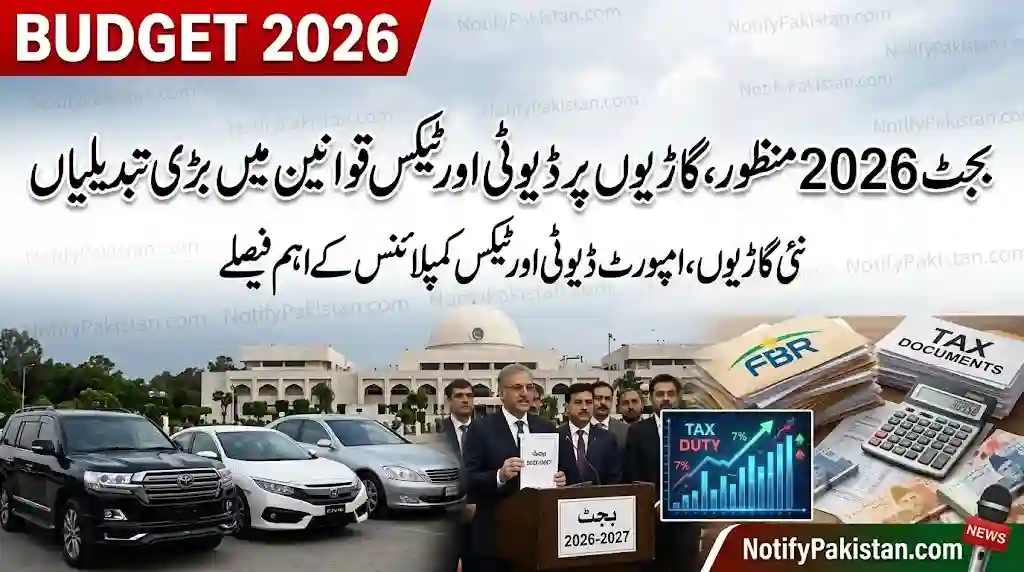
Pakistan’s National Assembly has officially approved the Federal Budget 2026–27, and its ripple effects are already being felt across boardrooms, car showrooms, and household budgets from Karachi to Khyber. This year’s budget is not a routine fiscal exercise. It represents a structural shift in how the government intends to collect revenue, regulate vehicle imports, and enforce tax compliance at a level the country has rarely seen before.
For vehicle buyers, the changes are immediate and significant. For businesses, the compliance pressure is higher than ever. And for non-filers — those Pakistanis who have long operated outside the documented economy — the walls are closing in rapidly. Whether you are planning to import a luxury SUV, buy a locally assembled hatchback, run a retail business, or simply manage your personal finances, the Budget 2026–27 has something that directly affects you.
The government’s stated objectives are clear: broaden the tax base, reduce reliance on indirect taxes, discourage luxury imports that drain foreign exchange reserves, and leverage digital technology to make tax evasion structurally difficult. The Finance Bill, presented by Finance Minister Muhammad Aurangzeb and now approved by parliament, is the legislative vehicle delivering all of these ambitions simultaneously.
This article provides a comprehensive, section-by-section breakdown of the most important changes — what they mean, how they work, and what Pakistani consumers, businesses, and the automotive sector should expect in the months ahead.
Overview of Pakistan Budget 2026–27
The Federal Budget 2026–27 arrives at a critical juncture in Pakistan’s economic recovery. With the country still navigating the conditions of its IMF bailout program and a tax-to-GDP ratio of approximately 10.6% — far below the potential of 15% — the government had no choice but to pursue aggressive revenue measures alongside carefully calibrated relief.
The budget’s architecture rests on three pillars: revising import duties on vehicles to protect foreign exchange and reshape the automobile sector; tightening FBR compliance rules to bring non-filers and undocumented businesses into the formal economy; and introducing digital tax enforcement tools that make evasion harder, not just more expensive.
The Finance Bill introduces wide-ranging fiscal reforms effective from July 1, 2026, covering vehicle taxes, electronic filing mandates, penalties for non-compliance, and a restructured excise duty framework targeting luxury goods.
New Vehicle Duty Structure and Tax Changes
The most talked-about feature of Budget 2026 is the sweeping overhaul of the vehicle duty structure. The new framework is a study in contrasts: significant relief for small-engine and affordable vehicles, and dramatically higher taxes on large-engine, high-value imported cars and luxury SUVs.
Relief for Smaller Vehicles
For everyday consumers and middle-income car buyers, there is genuine good news. Duties and taxes on imported vehicles with engine capacities between 1,000cc and 1,500cc have been reduced from 76% to 52% — a meaningful cut that could translate to lower prices in the used import segment. Even smaller 850cc vehicles benefit, with duties dropping from 66% to 42%. Additionally, under the new auto policy, special excise duty will no longer be imposed on locally assembled vehicles up to 1,800cc.
This relief is part of the Auto Policy 2026–31, which proposes a phase-wise reduction in maximum tariff rates — including Customs Duty (CD), Additional Customs Duty (ACD), and Regulatory Duty (RD) — to rationalize import costs and boost vehicle affordability at the mass-market end of the spectrum.
Heavier Taxes on Large-Engine Vehicles
At the premium end, the tax burden rises sharply. Imported vehicles with engine capacities between 2,000cc and 3,000cc now face an 86% duty, while those above 3,000cc are subject to a 92% duty. A new Special Excise Duty (SED) of 40% to 41% has been applied specifically to imported luxury vehicles and SUVs with engine capacities over 2,000cc — a measure explicitly designed to discourage non-essential luxury imports and protect Pakistan’s foreign exchange reserves.
What makes the SED particularly impactful is how it is calculated. It is not applied to the car’s original value, but rather to the assessed value plus the customs duty already applied — meaning the compounding effect is massive, potentially adding several crores to the final landed cost of a premium vehicle.
Token Tax and One-Time Fixed Tax
The budget also introduces a one-time fixed tax of Rs 10,000 on vehicles up to 1,000cc in the federal jurisdiction from July 1. Token tax on pre-2010 models of vehicles up to 1,000cc is set at Rs 20,000, while vehicles from 1,001cc to 1,300cc will face a token tax equal to 0.3% of the total invoice value. These changes add to the overall cost of vehicle ownership, particularly for older, smaller-engine cars.
Impact on Imported Cars and Luxury Vehicles
The message from Budget 2026 to luxury car importers and buyers is unmistakable: the era of relatively accessible high-end imported vehicles is over. The combined weight of a new SED of up to 41%, maintained high customs duties, and a fresh Federal Excise Duty (FED) on certain vehicle categories creates a tax wall around the premium import market.
High-profile examples illustrate the scale of impact. Industry analysts have noted that popular imported models like the Toyota Land Cruiser ZX could see prices climb by Rs 50 lakh or more, the Nissan GT-R by up to Rs 1 crore despite some regulatory duty reductions, and luxury electric vehicles like the Porsche Taycan and BMW i7 potentially rising by Rs 2.2 crore and Rs 1.7 crore respectively.
Crucially, even where the government has slightly reduced Regulatory Duty (RD) and Additional Customs Duty (ACD) on some categories, analysts warn buyers not to be misled. RD and ACD reductions apply to the car’s base value at the bottom of the tax chain, saving a relatively modest amount. The new SED and FED, applied at the top of the compounding tax chain on accumulated values, far outweigh those savings in rupee terms.
Changes in Customs Duties and Regulatory Duties
The customs duty framework has been restructured to reflect both the new Auto Policy 2026–31 and the government’s trade management priorities. The phase-wise reduction in maximum tariff rates represents a long-term commitment to rationalizing import costs — but not all vehicle categories benefit equally, and the timeline matters.
Four primary taxes apply cumulatively to imported vehicles in Pakistan: Customs Duty (varying by engine size and assembly type), Regulatory Duty (based on country of origin and trade policy), Sales Tax (standardized at 17%), and Advance Income Tax (ranging from 2% to 10% depending on importer registration status). The cascading, compounding nature of these taxes means that even a modest reduction in one layer can be negated by increases in another.
The government has rationalized some aspects of this structure under the Auto Policy 2026–31, but the overriding direction for the premium segment is toward higher total effective taxation, not lower.
New Tax Compliance Rules for Filers and Non-Filers
Perhaps the most consequential long-term change in Budget 2026 is not about vehicle duties at all — it is about tax compliance and the widening gap between those who file tax returns and those who do not.
The gap between filer and non-filer tax rates has widened further in 2026. Non-filers — those not on the FBR Active Taxpayer List (ATL) — now face significantly higher withholding tax on bank transactions, property purchases, vehicle registrations, prize bond winnings, dividend income, and cash withdrawals. The cost of non-compliance is no longer just a fine; it is a structural financial penalty embedded in every major transaction a person makes.
Electronic tax filing has been made mandatory from July 1, 2026. This removes the ambiguity that allowed many individuals and businesses to defer compliance indefinitely. FBR’s violations framework now stipulates significantly higher penalties for non-compliance with tax notices, signaling a stricter enforcement regime than Pakistan has previously implemented.
Violations and Penalties
Violations of FBR notices or failure to comply with tax requirements will result in significantly higher penalties under the new framework. The government has also moved to tighten action against fake and fictitious tax invoicing, a practice that has long undermined the integrity of the documented economy.
Digital Tax Monitoring and Documentation Measures
Budget 2026 marks a decisive shift toward a fully digitized tax enforcement architecture. The Federal Board of Revenue is now gaining online access to a centralized banking database, replacing the existing manual reporting processes that created persistent gaps in taxpayer tracking.
This real-time monitoring system will allow the FBR to cross-reference financial transactions with filed tax returns instantly, making it structurally difficult for non-compliant taxpayers to remain undetected. Prime Minister Shehbaz Sharif has personally directed the FBR to leverage this banking data effectively, underlining the political priority given to improving compliance.
FBR IRIS 2.0 and POS Integration
The FBR’s upgraded IRIS 2.0 portal now cross-references CNICs with NADRA databases in real time, allowing the system to flag individuals with significant financial activity — bank transactions, property transfers, vehicle purchases — who do not appear on the active taxpayer list. Businesses are now required to integrate with the FBR’s Point of Sale (POS) system or digital invoicing framework.
Businesses that fail to digitally integrate with the FBR within the prescribed timeline face fines of up to Rs 1 million, with penalties rising to Rs 5 million for continued non-compliance. Repeat violators may face the sealing of their business premises. Those found issuing fake invoices may be penalized the full value of the invoice, with the government also considering publishing a public list of violators.
SIM Card Blocking for Non-Filers
In a measure that has drawn widespread attention, the Pakistan Telecommunication Authority (PTA) is actively working with the FBR to block SIM cards of confirmed non-filers. This digital enforcement tool goes beyond financial penalties and into daily connectivity, making the consequences of remaining outside the tax net tangible and immediate for ordinary citizens.
Impact on Car Prices in Pakistan 2026
The net impact on car prices in Pakistan for 2026 is a tale of two markets. At the affordable end — 850cc to 1,800cc locally assembled vehicles — the new auto policy’s duty reductions and excise duty exemptions should help stabilize or even reduce prices modestly over time, particularly as the phase-wise tariff reductions under the Auto Policy 2026–31 take effect.
At the premium and luxury end, prices are rising sharply and immediately. The combined weight of the new SED, maintained high customs duties, and fresh FED on premium EVs means that imported luxury vehicles will become significantly more expensive. For buyers with pending bookings or vehicles at the port, the financial impact of clearing under the new duty structure is substantial.
For the mass market, the one-time fixed tax on vehicles up to 1,000cc and revised token taxes add to the overall cost of ownership, though these are relatively modest compared to the impact on the luxury segment.
Effect on Local Automobile Manufacturers
Local automobile manufacturers stand to benefit significantly from the Budget 2026 policy direction, though the picture is not without challenges.
The extension of tax relief for locally assembled Electric Vehicles (EVs) and Range-Extended Electric Vehicles (REEVs) until June 30, 2027 is a major win for domestic assemblers. Customs concessions on completely knocked-down (CKD) kits and localized EV parts remain intact, ensuring that local assembly lines remain financially viable. Tax exemptions for locally manufactured electric vehicles, hybrid cars, and e-bikes have been extended, directly supporting the nascent local EV ecosystem.
Tax relief has also been extended to electric bikes and e-scooters, with concessional duties on raw materials and parts for local e-bike manufacturers maintained. This supports the growing two-wheeler electric market and the millions of daily commuters who depend on affordable personal transport.
The broader strategy is transparent: penalize luxury imports and high-displacement engines while incentivizing local assembly and green technology. For established local manufacturers like Pak Suzuki, Atlas Honda, Toyota Pakistan, and Hyundai-Nishat, this creates a more protected competitive environment.
Benefits and Challenges for Consumers
For Pakistani consumers, Budget 2026 delivers a genuinely mixed outcome, depending on where you sit in the income spectrum and what your automotive and financial plans look like.
Benefits include:
- Lower duties on 850cc to 1,500cc imported vehicles, potentially improving affordability at the entry level
- Relief from special excise duty on locally assembled vehicles up to 1,800cc
- Extended tax incentives for locally made EVs and hybrid vehicles
- Income tax relief across four salary slabs for salaried individuals, improving purchasing power modestly
Challenges include:
- Significantly higher prices for imported luxury and large-engine vehicles
- New token taxes and one-time fixed taxes on vehicle ownership
- Mandatory tax filing and higher penalties creating compliance pressure
- Higher withholding taxes for non-filers on virtually every major financial transaction
- Risk of SIM card blocking and banking restrictions for confirmed non-filers
Government Revenue Targets and Economic Goals
The government expects to generate between PKR 400 billion and PKR 500 billion from the combined tax policy, enforcement, and administrative measures approved for the upcoming fiscal year. This revenue package is backed by the IMF as part of Pakistan’s ongoing bailout program, which includes specific mandates to broaden the tax base and bring documented economy targets to measurable benchmarks.
Pakistan’s tax-to-GDP ratio of approximately 10.6% — against a potential of 15% — underscores the scale of the challenge. The government’s dual approach of tightening compliance on existing taxpayers while bringing previously undocumented businesses and individuals into the formal economy reflects both the opportunity and the urgency.
With around 57,000 cases already flagged for potential audit through the FBR’s compliance risk management system, and the IMF requesting that at least 10% of high-risk cases be actively pursued, enforcement activity is expected to intensify significantly in the coming fiscal year.
Expert Opinions on the New Budget Measures
Economists and tax professionals have offered broadly supportive but cautionary assessments of the Budget 2026 measures. The consensus view is that the policy direction is correct — protecting foreign exchange, broadening the tax base, and digitizing enforcement — but the effectiveness will ultimately depend on implementation capacity.
As one analysis noted, the success of these measures will depend on enforcement capacity and the government’s ability to expand compliance among previously untaxed sectors. There is also concern about the cascading impact of the new SED and FED on luxury vehicles potentially exceeding what the market can absorb, potentially reducing overall transaction volumes rather than maximizing tax revenue.
Tax professionals advise businesses and individuals to treat the Budget 2026 not merely as a rate-change exercise, but as a documentation and compliance event. The FBR’s expanded digital tools mean that gaps between declared income and actual financial activity are far more likely to be detected than in previous years.
What Vehicle Buyers Should Expect in 2026
For prospective vehicle buyers in Pakistan, the practical implications of Budget 2026 are clear and immediate:
If you are buying a locally assembled car (up to 1,800cc): Prices should be relatively stable, with the excise duty exemption providing some protection against major price hikes. The local EV and hybrid segment remains well-incentivized.
If you are considering an imported small car (850cc to 1,500cc): The duty reductions in this segment may gradually improve affordability, but the full benefit will depend on how the market adjusts over the fiscal year.
If you are eyeing an imported luxury or large-engine vehicle: Expect prices to rise substantially. The new SED of 40%–41%, combined with maintained high customs duties and fresh FED on premium EVs, means the landed cost of luxury imports has increased dramatically. Factor in these changes before committing to any purchase or import order.
If you are registering a vehicle as a non-filer: Expect higher withholding taxes at the point of registration. Becoming a registered tax filer before completing a vehicle purchase is now a financially rational decision, not just a compliance obligation.
Future Outlook for Pakistan’s Automotive Industry
The long-term trajectory for Pakistan’s automotive industry under Budget 2026 points toward a clearer bifurcation: a well-incentivized, growing local assembly sector with a particular emphasis on electric vehicles and fuel-efficient small cars; and a significantly compressed imported luxury segment facing some of the highest effective tax rates in the region.
The Auto Policy 2026–31’s phase-wise tariff reduction signals a deliberate effort to gradually rationalize import duties over a five-year horizon, which could eventually improve the competitiveness of Pakistan’s automotive market and attract new investment. The extension of EV incentives for local assemblers, combined with the crackdown on luxury EV imports above certain price thresholds, reflects a nuanced strategy: encourage the transition to electric mobility domestically while preventing the forex drain of high-value luxury EV imports.
For the automotive industry as a whole, the policy is expected to stabilize the local assembly landscape, encourage further investment in domestic manufacturing, and promote long-term growth in Pakistan’s electric mobility ecosystem. However, the near-term disruption in the luxury import market — and the compliance costs for dealers and importers navigating the new digital enforcement environment — will require careful adjustment.
Summary: Key Takeaways from Pakistan Budget 2026
Pakistan’s Federal Budget 2026–27 is a landmark document for taxpayers, vehicle buyers, importers, and businesses. Its most important changes can be summarized as follows:
- Vehicle duty relief for 850cc to 1,500cc imported cars and locally assembled vehicles up to 1,800cc, as part of the Auto Policy 2026–31
- Heavy new taxes on imported vehicles above 2,000cc, with SED of 40%–41% and 86%–92% total duties on large-engine cars
- New FED on luxury EVs priced above Rs 2 crore (Rs 20 million), ending the tax-free era for premium electric imports
- Mandatory electronic tax filing from July 1, 2026, with significantly higher penalties for non-compliance
- Digital FBR enforcement through IRIS 2.0, real-time banking database access, POS integration mandates, and SIM card blocking for confirmed non-filers
- Wider filer vs. non-filer gap on withholding taxes across bank transactions, property, vehicles, and financial instruments
- Government revenue target of PKR 400–500 billion from the combined tax and enforcement package